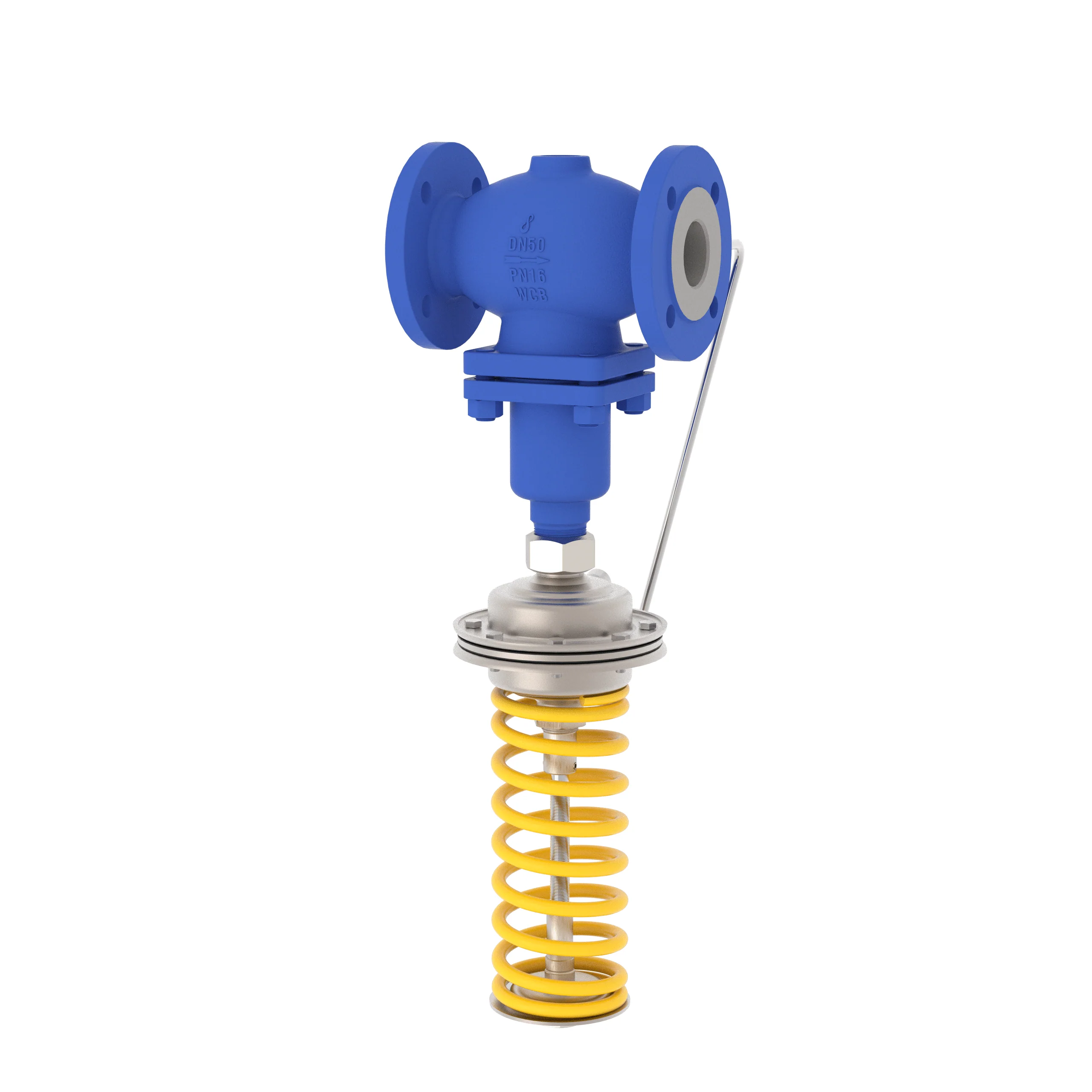
Self-Acting Pressure reducing Valve

Diaphragm-controlled spring-loaded and balanced proportional control valve for a broad selection of universal applications. The outlet pressure required is balanced across the control unit by the force of the valve spring (set pressure). As the outlet pressure rises above the set pressure using the adjusting screw, the valve cone moves around towards the seat and the volume of media is reduced. As the outlet pressure drops, the valve control orifice increases; when the pipeline is depressurised, the valve is open. Rotating the adjusting screw clockwise increases the set outlet pressure.

Connections: Flanged (DIN, ASME), Screwed (BSP,NPT)
Contact us for custom connections

pressure reducing valves in Kenya

Self Acting Pressure Reducing Valve for Kenya and African Industry

Self Acting Pressure Reducing Valve solutions in Kenya need to match the realities of local steam, process, and utility systems while remaining dependable across wider African industrial sites. Built around German quality expectations, the details below combine precise engineering, durable materials, efficient operation, and practical maintenance guidance for teams comparing pressure reducing valves Kenya suppliers, pressure reducing valves Africa applications, and long-life Self Acting Pressure Reducing Valve performance.

pressure reducing valves in Kenya

STEAM ENGINEERING · TECHNICAL BRIEFING

  • Steam Pressure
  • Reducing Valves
  • & PRV Stations
  • Why pressure reduction matters · the economics of operation · valve technologies (mechanical & control) · the pressure reducing station and the role of every component.
  • STEAM PRV SYSTEMS
pressure reducing valves across Africa

THE FUNDAMENTAL NEED

  • Why steam pressure must be reduced
  • Boilers generate and distribute steam at high pressure for efficient transport, but most equipment is rated — and operates most efficiently — at far lower pressure. The PRV bridges that gap.
  • Generate & distribute HIGH
  • Boilers run at high pressure so steam carries more energy per unit volume — smaller pipes, lower velocity, less heat loss over distance.
  • Utilise LOW & STABLE
  • Heat exchangers, jacketed vessels and turbines are designed for a specific lower pressure. Saturation temperature is set by pressure — process control depends on it.
  • Protect the equipment
African pressure reducing valves applications

THE GOVERNING PHYSICS

  • Pressure sets temperature — and that runs the process
  • For saturated steam, pressure and temperature are locked together by the saturation curve. Control the pressure and you control the heat-transfer temperature, the energy delivered, and the safety margin.
  • Heat at the right temperature
  • A jacketed pan needs ~150 °C, not 200 °C. Reducing to the matching pressure delivers the correct process temperature.
  • Stable set point = stable process
  • Tight pressure control means tight temperature control — fewer reject batches and consistent product quality.
  • Built-in safety margin
Kenya industrial systems

THE BUSINESS CASE

  • Economic benefits in operation
  • A correctly specified PRV is one of the lowest-cost devices in the steam loop, yet it directly governs fuel use, product quality and equipment life. The operating savings dwarf the capital cost.
  • Fuel & energy savings
  • Matching steam pressure to the actual process load avoids wasteful over-heating and reduces flash/blow-through losses across the plant.
  • Less steam consumed
  • Lower delivery pressure means lower saturation temperature and condensate sub-cooling control — steam is used, not wasted to atmosphere.
  • Lower maintenance cost
Africa process plants

WHERE THE MONEY GOES

  • Operating-cost impact at a glance
  • THE PAYBACK STORY
  • Low capital cost
  • A PRV or PRV station is a small fraction of total plant steam-system spend.
  • Continuous return
  • Savings accrue every operating hour — not a one-off gain but a permanent reduction in run-rate cost.
  • Lower emissions
pressure reducing valves in Kenya

PART 02

  • Types of Pressure
  • Regulating Valve
  • Mechanical (self-acting) regulators · pilot-operated regulators · pneumatic control valves with controllers. How each senses, acts and performs.
  • STEAM PRV SYSTEMS
pressure reducing valves across Africa

MECHANICAL

  • Direct-acting (self-acting) pressure regulator
  • The simplest PRV. Downstream pressure acts on a diaphragm that works directly against a spring; the balance of forces positions the valve plug. No external power or controller needed.
  • FRAME 1
  • 1 · Demand rises
  • → outlet pressure falls
  • FRAME 2
  • 2 · Spring overcomes diaphragm
African pressure reducing valves applications

MECHANICAL: Pilot-operated pressure regulator

  • Pilot-operated pressure regulator
  • A small pilot valve senses downstream pressure and modulates a control pressure on top of the main diaphragm. This amplifies the sensing signal, giving far tighter control and much higher capacity than direct-acting designs.
  • SCHEMATIC
  • PILOT
  • VALVE
  • control pressure
  • sensing line
Kenya industrial systems

CONTROL VALVE

  • Pneumatic control valve with external controller
  • Sensing, decision and actuation are separated. A transmitter measures pressure, a controller (PID) compares it to set point, and a positioner drives a pneumatic actuator on the valve. Maximum flexibility and precision for demanding or variable loads.
  • PRESSURE
  • TRANSMITTER
  • CONTROLLER
  • (PID)
  • POSITIONER /
Africa process plants

CHOOSING THE RIGHT DEVICE

  • Mechanical vs. control valve — at a glance
  • Attribute
  • Direct-acting
  • Pilot-operated
  • Control valve
  • Accuracy / droop
  • Moderate (some droop)
pressure reducing valves in Kenya

PART 03

  • The Pressure
  • Reducing Station
  • A PRV alone is not enough. A complete station surrounds it with isolation, filtration, separation, protection and measurement so the valve performs reliably and safely — for years.
  • STEAM PRV SYSTEMS
pressure reducing valves across Africa

TYPICAL ARRANGEMENT

  • Anatomy of a pressure reducing station
  • A detailed schematic of the piping train: steam enters at high pressure (left) and leaves controlled at low pressure (right).
  • HIGH-PRESSURE STEAM
  • REDUCED, CONTROLLED STEAM
  • Inlet isolation valve
  • Y-type strainer
  • Separator + steam trap
African pressure reducing valves applications

COMPONENT BY COMPONENT

  • Why each part of the station matters
  • Isolation valves
  • Full-bore stop valves up- and downstream let the station be isolated for inspection or repair without draining the whole system.
  • Strainer / filter
  • Removes pipe scale, rust and debris before the PRV — protecting the precision seat and trim from erosion and sticking.
  • Separator & trap
  • Removes entrained condensate so dry steam reaches the valve. Prevents wiredrawing, water hammer and erosion of the seat.
Kenya industrial systems

IN SUMMARY

  • Key takeaways
  • Pressure reduction is fundamental
  • It matches high-pressure distribution to the lower, stable pressure equipment needs — and sets the process temperature.
  • The economics are compelling
  • Lower fuel use, less wasted steam, longer equipment life and better product quality recover the cost quickly.
  • Pick the right valve type
  • Direct-acting for simple steady loads, pilot-operated for tighter high-capacity control, control valves for variable/critical duty.

Product Documents

Documents for this product are coming soon

Related Items