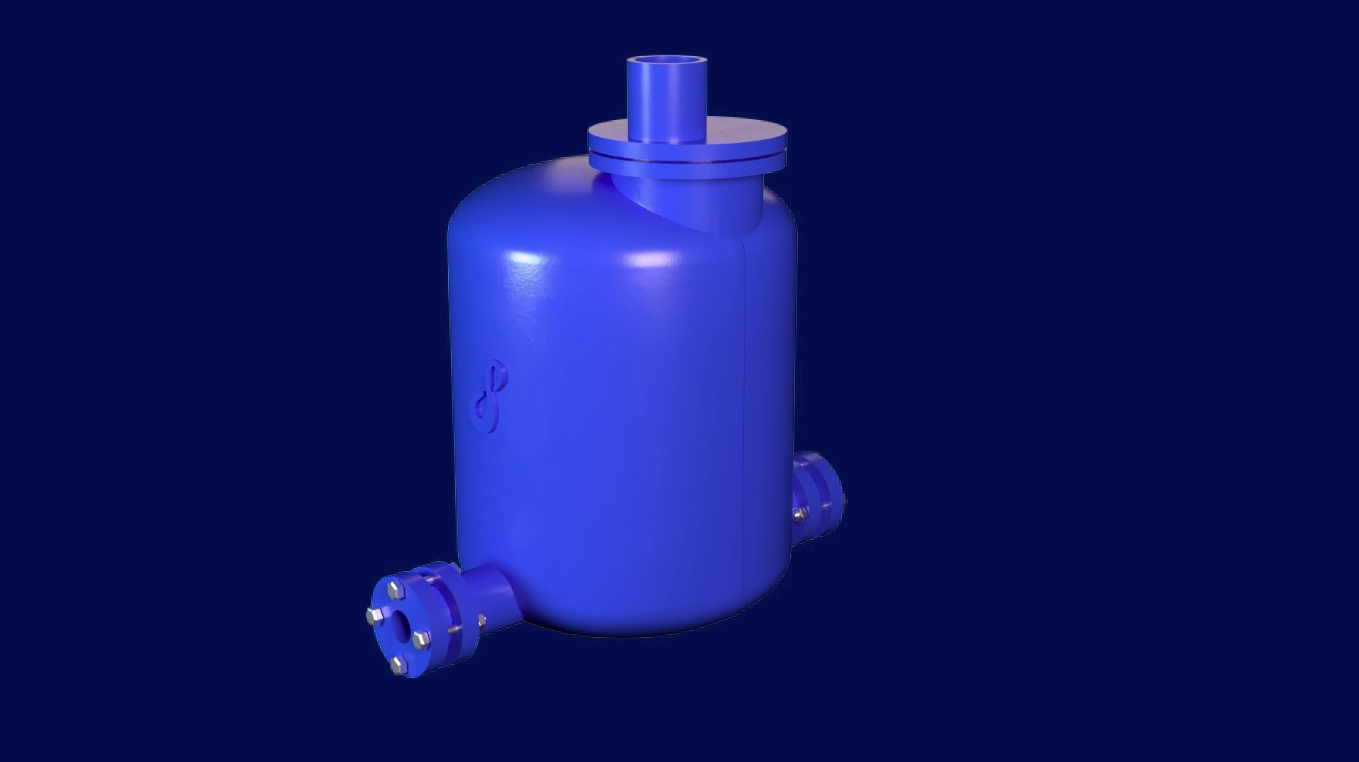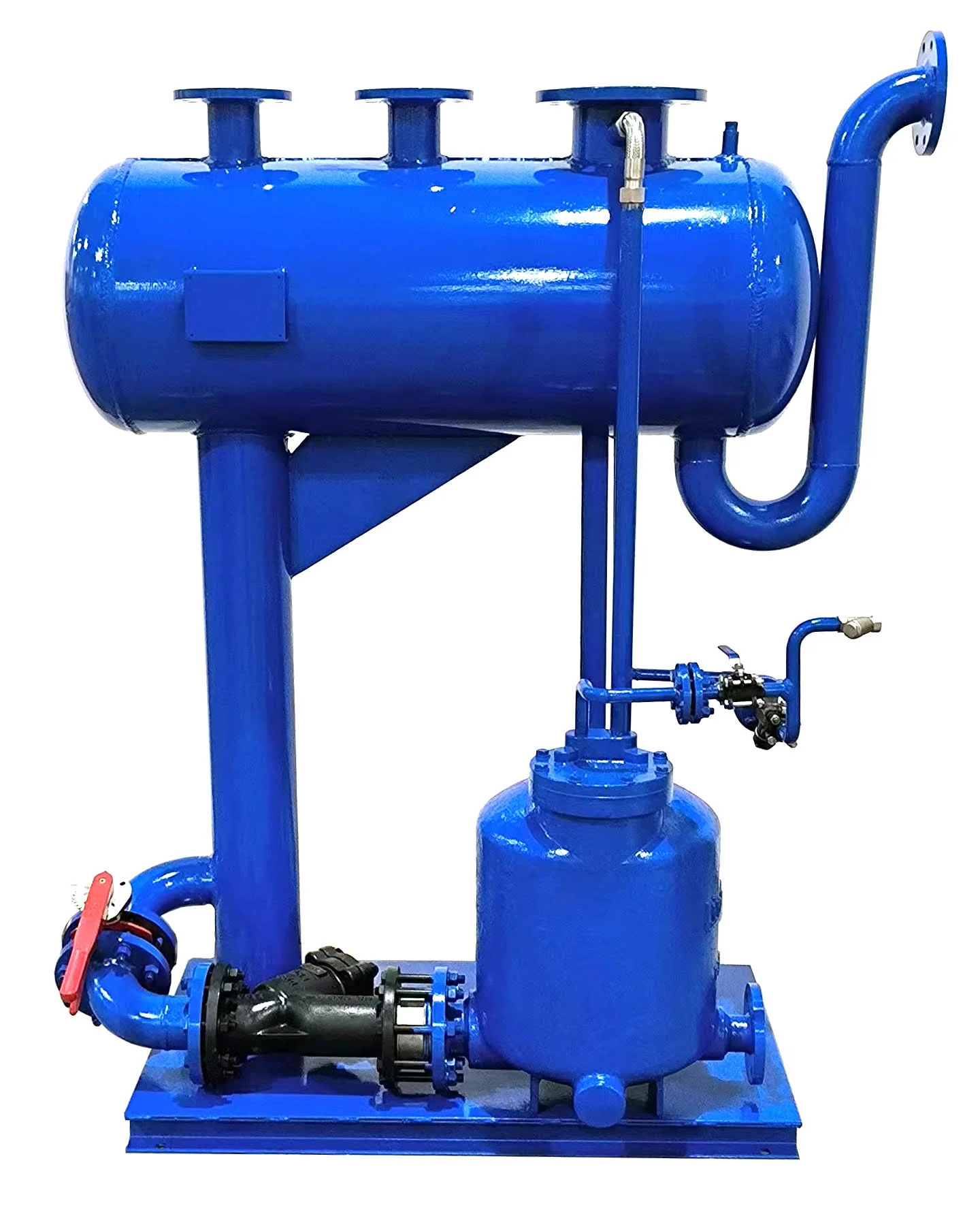
Condensate Pump

Whether in industrial production or residential facilities, steam is widely used as a versatile energy source. After steam releases its heat during heat exchange, the resulting condensate still contains approximately 20% of the total energy. Discharging this condensate directly leads to significant waste of both heat and water resources. By implementing an efficient condensate recovery system, enterprises can capture this valuable resource, resulting in substantial savings and considerable economic benefits through reduced energy and water costs.

Working Principle

  • Inlet and Exhaust Process: Initially, the inlet check valve opens while the outlet check valve remains closed due to high back pressure. Water begins to enter the pump, causing the float to be in a low position. As the water level rises, the exhaust valve opens, and the float reaches its highest position, triggering the controller to switch to a neutral state.
  • Inlet Steam (Gas) Drainage: Once the float reaches a high position, the controller activates, closing the exhaust valve and opening the power steam (or air) inlet. Steam is injected into the valve, pushing the condensate in the pump to a high-pressure area using steam pressure. During this process, the inlet check valve remains closed due to the high internal pressure. When the float drops to a low position, the controller switches again, closing the power steam inlet, opening the exhaust valve, and initiating the next cycle.

Performance Characteristics

  • Non-Electric Drive: The pump is powered by steam or compressed air, making it explosion-proof, safe, and suitable for any environment.
  • Compact Structure: It has no specific installation requirements and can operate normally even in open environments.
  • Automatic Control: The water output is automatically adjusted based on the intake. As the volume of condensate increases, the working frequency accelerates; when it decreases, the frequency slows down. The pump stops when there is no condensate.
  • Cavitation-Free Operation: It completely eliminates the cavitation issues found in electric pumps.
  • Durable Construction: All internal parts are made of stainless steel, and special materials are used to ensure optimal performance and longevity.

The significance of recovering condensate

  • Reduce water treatment costs.
  • Reduce water usage and costs.
  • Reduce boiler blowdown and save fuel.
  • Avoid the cost of high temperature discharge of sewage.
  • Recovering condensed water means recovering a large amount of heat
  • energy, saving energy consumption and reducing usage costs.

Solutions for condensate recovery

  • Traditional solution: Combination of water tank and electric pump.
  • Mechanical Condensate Recovery Unit.
condensate recovery systems Kenya

Condensate Pump for Kenya and African Industry

Condensate Pump guidance for industrial buyers comparing condensate recovery systems Kenya options, condensate recovery systems Africa applications, and German quality product expectations from Spenomatic Energy Solutions.

Condensate recovery systems in Kenya

Mechanical Condensate Recovery for Boiler Efficiency

  • The catalog notes that mechanical condensate recovery can operate without external electrical power, using steam or compressed air as the motive source.
  • Recovering condensate reduces water treatment costs, water usage, boiler blowdown, fuel demand, and the cost of discharging high-temperature wastewater.
  • For industrial sites in Kenya and across Africa, the system helps recover both water and useful heat energy from steam processes.
German quality condensate pump design

Compact Pumping Without Cavitation Problems

  • The PDF contrasts mechanical recovery with traditional electric pump and tank systems, highlighting smaller installation space and lower energy consumption.
  • Because the unit is driven by steam or compressed air, it avoids the cavitation risks often seen when hot condensate is handled by electric pumps.
  • Stainless-steel internal components, cast-steel body construction, and alloy/compression springs support long service life in demanding boiler houses.
Condensate recovery systems Africa

Open and Closed Recovery Applications

  • Open condensate recovery is suitable for multiple devices where a simple system layout is preferred.
  • Closed condensate recovery can recover flash steam and high-temperature condensate up to 198°C, avoiding expensive atmospheric vent piping.
  • Ordering details should include operating pressure, back pressure, operating temperature, connection type, flow, and size.
SKL-CRS operating range

Condensate Pump Selection Details

  • Catalog model reference: SKL-CRS mechanical condensate recovery unit.
  • Maximum operating pressure is listed as 13.8 bar, with maximum operating temperature up to 198°C.
  • Typical flange sizes listed include DN80, DN50, and DN25, with single pump, double pump, and pump-and-steam-trap combinations.

Product Documents