What if one product could replace two?
In many industrial steam systems, improving efficiency doesn’t always require a major plant upgrade.
Sometimes, the biggest improvements come from simplifying the design.
A conventional steam trap installation typically requires two separate components:
- A Ball Float Steam Trap
- A Separate Inline Strainer
While this arrangement has been used for years, it introduces additional piping, more flange connections, extra maintenance, and higher installation costs.
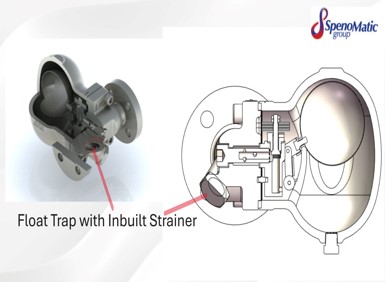
The Ball Float Trap with Inbuilt Strainer combines both functions into a single engineered unit, delivering the same reliable condensate removal while reducing installation complexity, maintenance requirements, and long-term operating costs.
Why Is a Strainer Important?
Steam systems naturally carry contaminants.
These include:
- Rust particles
- Pipe scale
- Welding debris
- Dirt introduced during maintenance
- Other solid contaminants
If these particles reach the steam trap mechanism, they can damage valve seats, restrict movement of the float, or prevent the trap from sealing correctly.
The result can be:
- Steam leakage
- Reduced efficiency
- Frequent maintenance
- Premature trap failure
This is why strainers are commonly installed immediately before steam traps.
The Smarter Solution: An Integrated Design
Instead of installing two separate pieces of equipment, the Ball Float Trap with Inbuilt Strainer integrates the strainer directly into the trap body.
This means incoming condensate is filtered before it reaches the internal float mechanism.
The benefits are immediate:
- No additional inline strainer required
- Fewer pipe fittings
- Less installation time
- Smaller installation footprint
- Better protection of internal components
It is a simpler solution that delivers better long-term performance.
Conventional Installation vs. Inbuilt Strainer Design
| Conventional Ball Float Trap | Ball Float Trap with Inbuilt Strainer |
| Separate strainer required | Integrated strainer |
| More piping components | Compact single unit |
| More flange joints | Fewer leak points |
| Two maintenance locations | One maintenance point |
| Higher installation cost | Lower installed cost |
| More shutdown time | Faster servicing |
| Greater risk of debris damage | Internal components protected |
By combining two essential components into one engineered solution, plants reduce both capital costs and ongoing maintenance requirements.
How the Inbuilt Strainer Works
The operating principle remains the same as a conventional ball float trap—but with an important improvement.
Step 1: Steam and Condensate Enter
Wet steam enters the trap body carrying condensate and any suspended debris.
Step 2: Debris Is Filtered
Before reaching the float mechanism, the integrated strainer captures rust, scale, and other contaminants.
Step 3: Condensate Collects
Condensate accumulates inside the lower chamber, causing the stainless-steel float to rise.
Step 4: The Valve Opens
As the float rises, it opens the discharge valve, allowing condensate to leave the trap continuously.
Step 5: Steam Is Retained
When condensate has been discharged, the float drops and closes the valve, preventing valuable live steam from escaping.
This automatic cycle repeats continuously, ensuring efficient condensate removal while protecting the trap from debris-related damage.
Six Reasons Engineers Choose the Ball Float Trap with Inbuilt Strainer
1. Lower Installation Costs
Because the strainer is already built into the trap, installers eliminate:
- An additional valve
- Extra flanges
- Additional pipe sections
- Separate supports
- Extra labour
Fewer components mean faster installation and lower project costs.
2. Fewer Leak Points
Every flange and threaded connection represents a potential leak path.
By reducing the number of joints, the integrated design improves system reliability while reducing steam losses.
3. Better Protection Against Debris
One of the leading causes of steam trap failure is contamination.
The integrated strainer captures debris before it reaches the float mechanism, helping extend equipment life and reduce unplanned failures.
4. Easier Maintenance
Maintenance teams only need to service one assembly instead of two.
This means:
- Faster inspections
- Shorter shutdowns
- Reduced labour
- Lower maintenance costs
5. Space-Saving Design
Many existing steam systems have limited installation space.
Replacing two separate components with one compact unit makes the Ball Float Trap with Inbuilt Strainer ideal for:
- Retrofit projects
- Compact skid systems
- Congested pipe racks
- Process equipment with limited access
6. Lower Total Cost of Ownership
Although procurement cost is only one consideration, the overall lifecycle cost tells the real story.
An integrated design can reduce:
- Installation costs
- Maintenance costs
- Downtime
- Spare parts inventory
- Steam losses
Over the life of the equipment, these savings often outweigh the initial purchase price.
Typical Applications
The Ball Float Trap with Inbuilt Strainer is suitable for a wide range of steam applications, including:
Food and Beverage
- Sterilizers
- Cooking systems
- Clean steam lines
- CIP systems
Pharmaceutical
- Autoclaves
- Process heating
- Clean steam distribution
Chemical and Petrochemical
- Process heating
- Reactor jackets
- Steam tracing
Power Generation
- Utility steam headers
- Boiler feed systems
- Steam turbine support systems
HVAC
- Heating coils
- Steam humidifiers
- Heat exchangers
Marine and Offshore
- Fuel oil heating
- Shipboard steam systems
- Offshore utility services
These applications benefit from continuous condensate removal and enhanced protection against debris, making the integrated design particularly valuable in demanding industrial environments.
Frequently Asked Questions
What is a Ball Float Trap with Inbuilt Strainer?
It is a steam trap that combines continuous condensate drainage with an integrated strainer, eliminating the need for a separate inline strainer while protecting the internal float mechanism from debris.
Why is an integrated strainer better?
An integrated strainer reduces installation costs, minimises leak points, simplifies maintenance, and protects the trap from contamination.
Can it replace a conventional trap and strainer?
Yes. The Ball Float Trap with Inbuilt Strainer is designed to perform both functions within a single compact unit, reducing components without compromising performance.
Is it suitable for retrofit projects?
Absolutely. Its compact design makes it an excellent choice for replacing conventional trap-and-strainer assemblies where installation space is limited
Why Choose Spenomatic Energy Solutions?
At Spenomatic Energy Solutions, we supply German-standard Ball Float Traps with Inbuilt Strainers designed to deliver reliable condensate removal while reducing installation complexity and maintenance costs.
Our engineering team can help you:
- Select the correct trap for your application
- Optimise your steam system design
- Reduce energy losses
- Improve condensate recovery
- Increase overall steam system reliability
Whether you’re designing a new steam installation or upgrading an existing plant, we provide practical engineering solutions that improve long-term performance.
Talk to Our Steam Engineers About Your Application
This feels far more consultative and aligns with how industrial procurement teams typically engage suppliers. It also matches the presentation’s emphasis on technical datasheets, sizing assistance, and project quotations, making the article consistent with the supporting material.